Grocery shoppers under financial pressure are spending more per purchase, giving retailers an opportunity to help households manage bigger bills with more flexible ways to shop and pay.
That’s a central finding of “The New Checkout: Crimped Consumers Lean Into Online Retail and Digital Wallets,” a PYMNTS Intelligence report based on a survey of 2,108 U.S. adults conducted from Nov. 14 to Dec. 8, 2025. The research connects financial stress with greater use of online grocery shopping, stronger demand for value-focused merchants and higher digital wallet adoption. High-stress consumers spent an average of $109 on their latest grocery purchase, compared with $95 among low-stress consumers. Bigger purchases don’t necessarily indicate greater financial comfort. The report suggests they could reflect larger households or efforts to consolidate shopping into fewer trips. For grocers and payment providers, the findings point to an opportunity to help customers manage costs while keeping checkout straightforward.
We’d love to be your preferred source for news.
Please add us to your preferred sources list so our news, data and interviews show up in your feed. Thanks!
Three findings show where those opportunities lie:
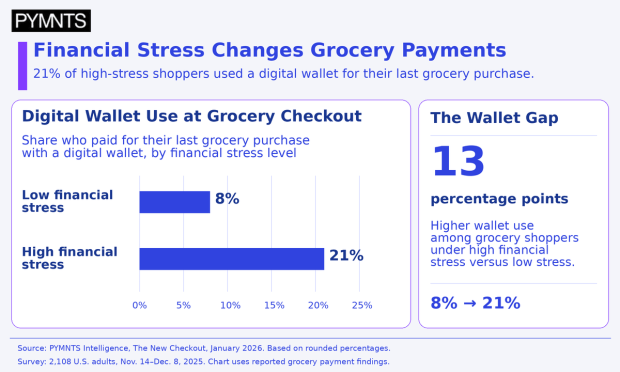
- Digital wallets have gained ground at the grocery checkout. Among high-stress consumers, 21% used a digital wallet for their latest grocery purchase, compared with 8% of low-stress consumers, a 13-percentage-point gap. Adoption among the high-stress group rose from 10% in March 2024 to 21% in November 2025. The report suggests that access to installment payments and spending information may help explain the appeal. A wallet can serve as a household’s financial dashboard, putting payment choices and spending information within reach.
- Walmart attracts a larger share of financially stressed shoppers. Among high-stress online grocery shoppers, 56% made their latest purchase at Walmart, compared with 50% of low-stress shoppers. The difference was wider in stores: 37% versus 26%. Those results suggest that consumers facing tighter budgets seek value across shopping channels. Grocers have an opening to make savings easier to find wherever customers choose to buy.
- Online grocery shopping appeals to consumers under pressure. High-stress consumers were 6 percentage points more likely than low-stress consumers to purchase groceries online. The report suggests digital discounts and greater budget control could contribute to that difference. Convenience could also play a role for people with limited time to visit a store. The findings don’t establish which explanation carries the most weight.
The broader findings show why practical help could find a receptive audience. About one in four parents with children under 18 experienced high financial stress, as did roughly one in four millennials and Gen Z consumers. Yet grocery purchase amounts overall remained relatively stable, averaging $98 in November 2025 versus $95 in January. Households are still buying essentials, giving grocers an opportunity to support repeat purchases through accessible savings and useful payment choices.
At PYMNTS Intelligence, we work with businesses to uncover insights that fuel intelligent, data-driven discussions on changing customer expectations, a more connected economy and the strategic shifts necessary to achieve outcomes. With rigorous research methodologies and unwavering commitment to objective quality, we offer trusted data to grow your business. As our partner, you’ll have access to our diverse team of PhDs, researchers, data analysts, number crunchers, subject matter veterans and editorial experts.


 Add as Preferred Source