Consumers under financial pressure are buying bigger baskets and choosing value-focused merchants, giving retailers an opportunity to help shoppers make each purchase go further.
That’s a central finding of “The New Checkout: Crimped Consumers Lean Into Online Retail and Digital Wallets,” a PYMNTS Intelligence report based on a survey of 2,108 U.S. adults. The research examines how financial stress influences grocery purchases, retail shopping and payment choices. Its findings suggest that pressure on household budgets doesn’t translate neatly into smaller purchases. Instead, consumers facing cash shortages shop differently, with greater use of online grocery channels and stronger preferences for certain merchants.
We’d love to be your preferred source for news.
Please add us to your preferred sources list so our news, data and interviews show up in your feed. Thanks!
For retailers and payment providers, those patterns offer clues about how to serve customers who need greater control over their spending.
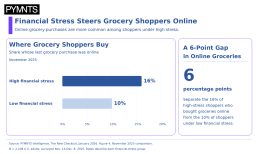
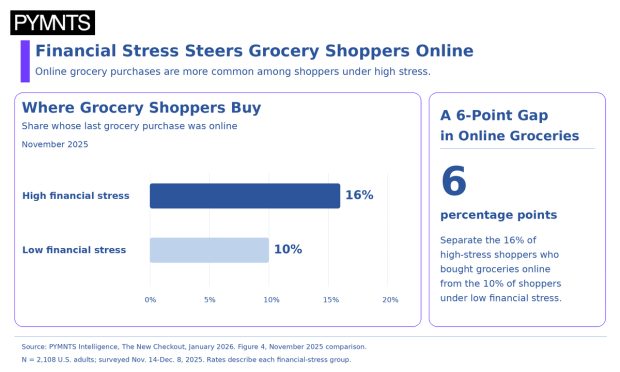
- Online groceries attract financially stressed shoppers. Consumers under high financial stress are 6 percentage points more likely than those under low stress to have made their latest grocery purchase online, at 16% versus 10%. Online shopping can function like a calculator beside the grocery cart, helping shoppers track the total as they add items. The report suggests digital discounts and convenience may also explain the difference, although financial strain doesn’t increase online shopping overall.
- Larger purchases can accompany tighter budgets. High-stress consumers spent an average of $109 on their latest grocery purchase and $111 on their latest retail purchase, compared with $95 and $88 among low-stress consumers. The online retail gap was wider, at $169 versus $96. Larger households could explain some of the difference. Consumers may also consolidate purchases to reduce shipping costs or capture promotions. The findings don’t establish whether they spend more overall or shop less frequently.
- Walmart draws more shoppers facing financial pressure. Among online grocery shoppers under high stress, 56% made their latest purchase at Walmart, compared with 50% among low-stress shoppers. For in-store groceries, the shares were 37% and 26%, an 11 percentage point difference. High-stress in-store retail shoppers were also more likely to choose Dollar Tree. These preferences suggest an opening for merchants that make value easy to find across stores and digital channels.
Payment choices show another opportunity to support these customers. Among high-stress consumers, 21% used a digital wallet for their latest grocery purchase and 28% for retail, compared with 8% and 11% among low-stress consumers. The report suggests access to installment payments and spending tools may contribute to adoption. Still, financial experiences vary: 62% of respondents reported no cash shortfalls for living expenses or emergencies in the previous 90 days.
At PYMNTS Intelligence, we work with businesses to uncover insights that fuel intelligent, data-driven discussions on changing customer expectations, a more connected economy and the strategic shifts necessary to achieve outcomes. With rigorous research methodologies and unwavering commitment to objective quality, we offer trusted data to grow your business. As our partner, you’ll have access to our diverse team of PhDs, researchers, data analysts, number crunchers, subject matter veterans and editorial experts.


 Add as Preferred Source