Third-party fraud involves someone misusing another person’s account or identity. A fraudster who pays a credit card bill with someone else’s bank account is counting on the issuer to restore the card’s spending power before the payment comes back. Any new charges before the payment is returned leave the issuer with a larger balance to recover.
Public.com can give customers buying power before a bank deposit settles. Customers must wait for the deposit to settle before withdrawing those funds. Stephen Sikes, chief operating officer at Public.com, said the risk comes when money leaves the brokerage while the original ACH debit is still eligible for return.
John Lynch, vice president of fraud at Avant, said fraudsters study when the lender sends its nightly ACH file and when a payment can still be returned. When an unauthorized-debit return comes alongside increased account activity, his team may listen to customer calls. His team tries to determine whether Avant debited the account before the customer was ready or someone took over the account, Lynch said during a PYMNTS roundtable discussion.
First-party fraud occurs when customers use another approach in hopes of deception. Sikes described customers who use their own identities and real funds, then falsely dispute a debit they authorized.
Sikes compared the behavior to the Chase ATM scheme that circulated on TikTok. “In the past, you might have seen it from a true fraud ring,” he said. He said people acting on their own now share ways to exploit payment platforms.
Stolen credentials are another route to third-party fraud. Sikes recalled fraudsters buying ads on narrow search terms so customers saw a copy of Public’s site ahead of the genuine one. Sikes said artificial intelligence (AI) makes it easier to build English-language copies.
What Firms Check Before the Money Leaves
ACH still handles most incoming payments in the mix described by Brian Dammeir, Plaid’s general manager and global head of payments and financial management.
Sikes said firms need to know how their exposure changes as the grounds for returning a debit change. He pointed to two ACH return codes, R01 for insufficient funds and R10 for certain unauthorized debits. The window for an insufficient-funds return is shorter than the window for certain unauthorized-debit returns. Sikes said firms also need to understand the risk that remains after those deadlines.
Dammeir said firms deciding when to make funds available look first at whether the incoming debit is likely to go through. They also have to account for fraud that surfaces after the first few days.
At Avant, the decision to restore credit also depends on how long the customer has been with the lender and whether the bank account they’re paying from appears to be theirs. Plaid’s Signal product supplies separate scores for bank-initiated and customer-initiated ACH return risk. Dammeir said activity across connected apps can give firms evidence they wouldn’t see in their own records, particularly when someone is transacting under their own name.
Brokerage customers want to act on a price while it’s available. Public scores each deposit before granting buying power.
Businesses can use the RTP® Network and FedNow® Service to send payouts that settle immediately and with finality. To a customer, an advance against an ACH deposit and an instant payout can look equally fast.
When it comes to moving money, “they expect it to be real time,” Dammeir said of consumers. Public screens withdrawals more closely when a new customer tries to take money out within the first 60 days after making a deposit, Sikes said.
Public charges for instant withdrawals, so tighter screening also has a revenue cost. Sikes asked his risk team to find requests it could approve without increasing fraud losses. “We saw 12, 15% growth in instant withdrawal revenue at the same risk budget,” he said.
Sikes said Public had improved its ability to recover money over the past year by warning customers suspected of fraud that it could flag them through an industry consortium.
Public uses language models to compare dashboard readings with customer support feedback for signs of account abuse or takeover. Avant uses generative AI to look for patterns in scams, including cases in which an impersonator persuades the legitimate cardholder to authorize purchases.
Dammeir described using AI agents to probe a firm’s own systems. “That used to be a deep area of expertise where I would have to actually have an engineer, maybe an engineering manager, a product manager,” he told the panel. A card issuer could test the sequence Lynch described by seeing whether its controls intervene before a suspect payment frees up credit the cardholder can spend.
Watch the full PYMNTS On Air Roundtable to learn more about:
- How card issuers decide when a payment should restore spending power.
- Why brokerages apply different controls to deposits and withdrawals.
- How fraud teams use AI to investigate suspicious activity and test their own controls.
About the Speakers
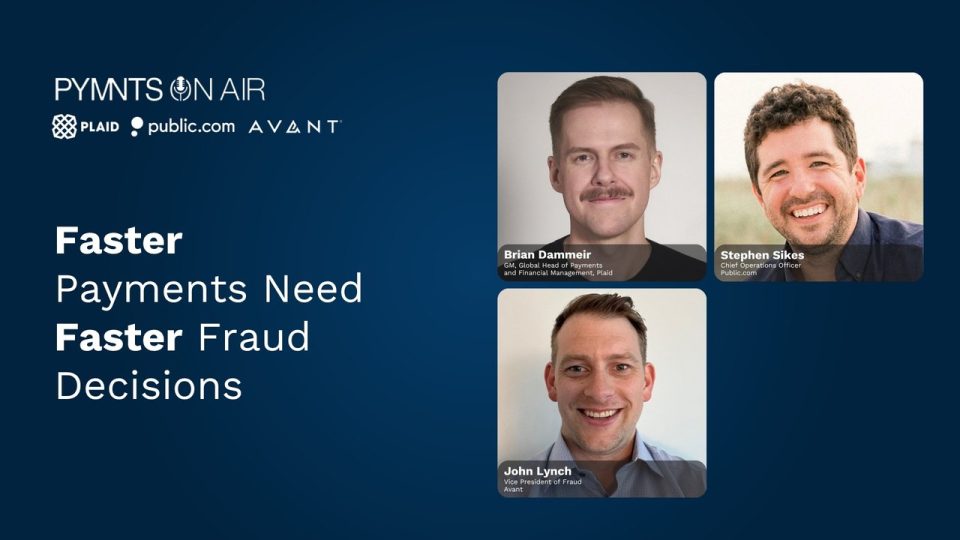
Brian Dammeir is Plaid’s general manager and global head of payments and financial management.
Stephen Sikes is chief operating officer at Public.com, an investment platform.
John Lynch is vice president of fraud at Avant, a consumer lender.