Banks have an opportunity to strengthen fraud protection by helping customers recognize when someone is persuading them to send money to a criminal.
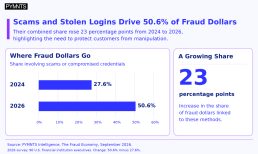
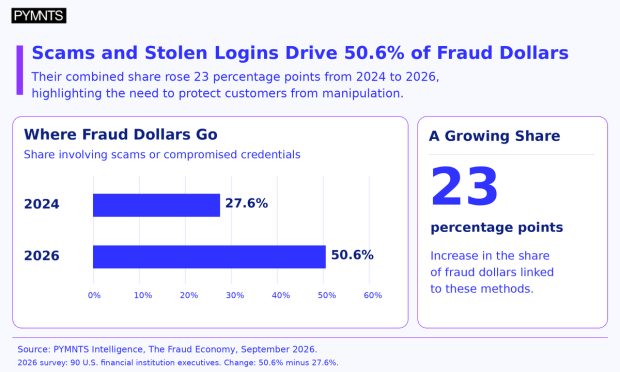
That’s a central finding of “Scams Get Personal: Why Banks Pay More to Fight Fraud,” the September 2026 edition of PYMNTS Intelligence’s “The Fraud Economy.” Based on a July survey of 90 executives at U.S. banks, credit unions and FinTechs, the report finds widespread adoption of detection tools hasn’t stopped fraud involving stolen credentials or manipulated customers. Together, those methods accounted for 50.6% of fraud dollars in 2026, up from 27.6% in 2024. The 23-percentage-point increase points to an opportunity to pair technology with clearer customer guidance. A strong lock offers limited protection when someone convinces the resident to open the door.
We’d love to be your preferred source for news.
Please add us to your preferred sources list so our news, data and interviews show up in your feed. Thanks!
Key Points:
- Banks have expanded their detection capabilities. Every surveyed institution now uses tools that analyze behavior, identify devices and verify identity through security prompts or personal details. Adoption stood at 81%, 95% and 68%, respectively, in 2025. Another 96% use machine learning and artificial intelligence. Those figures show that banks have established a broad technology foundation. The challenge is recognizing fraud when a payment comes from a customer’s actual account and carries that customer’s approval.
- Customer manipulation accounts for a growing share of fraud dollars. Scams in which account holders were persuaded to act represented 22.4% of fraud dollars, up from 12% in 2025. Fraud involving a personal relationship or cultivated trust rose to 12.6% from 6%. Separately, account takeover through compromised credentials accounted for 28.2% of fraud dollars. These findings suggest banks need to consider both who’s making a payment and whether someone has misled that person about its purpose.
- Banks see customer communication as a practical next step. Improved communication is the leading investment planned for the coming year, cited by 78% of institutions, up from 41% in 2025. That 37-percentage-point increase comes as 69% report damage to customer loyalty from fraud. Banks have a clear reason to make warnings understandable and timely: Helping customers recognize a scam may also help preserve the relationship after an attempted fraud.
Other findings offer encouragement while showing where work remains. Large banks reduced average fraud losses to $9 million from $16.8 million in 2025 while holding prevention spending roughly flat. Among institutions using machine learning, 86% say it helps them catch problems proactively, up from 25%. Still, 78% cite the complexity of new technology systems as their top innovation barrier. Banks’ next gains may depend on making existing tools work together and giving customers guidance they can act on.
At PYMNTS Intelligence, we work with businesses to uncover insights that fuel intelligent, data-driven discussions on changing customer expectations, a more connected economy and the strategic shifts necessary to achieve outcomes. With rigorous research methodologies and unwavering commitment to objective quality, we offer trusted data to grow your business. As our partner, you’ll have access to our diverse team of PhDs, researchers, data analysts, number crunchers, subject matter veterans and editorial experts.


 Add as Preferred Source