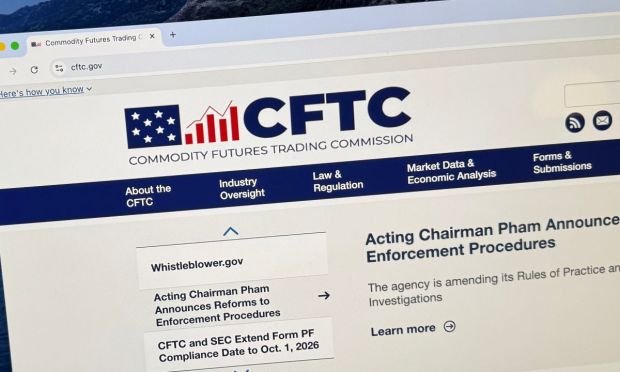
The Frontier Forum series, hosted by the CFTC’s Innovation Task Force, will kick off next month with a discussion of artificial intelligence and agentic finance, the regulator announced Monday (Sept. 21).
“The technologies transforming our markets are rapidly advancing, and the CFTC must engage directly with the people building, using, and studying them,” said CFTC Chairman Michael S. Selig said in the announcement.
According to the commission, the forums are designed to provide a venue for public discussion on new financial technology, bringing together “ builders and leaders” from the public and private sectors to discuss how the CFTC “can promote responsible innovation while protecting market participants and preserving the integrity and resilience of U.S. financial markets.”
The inaugural forum is scheduled for Oct. 28, the commission added. Members of the public can submit speaker nominations by writing to Innovation@CFTC.gov.
Meanwhile, PYMNTS wrote Monday that as states and local governments experiment with AI systems that can act on their own, the Urban Institute is calling on governments to put governance structures in place before those systems are embedded in public services.
“The institute’s new agentic AI playbook is designed to help state and local officials prepare for and maintain responsible deployments as governments look to the technology to cut costs, streamline operations and improve services,” that report said.
We’d love to be your preferred source for news.
Please add us to your preferred sources list so our news, data and interviews show up in your feed. Thanks!
“Unlike conventional generative AI, agentic systems can go beyond producing content to independently plan and act toward a goal.”
PYMNTS also recently looked at the role agentic systems play in financial compliance questions in an interview with Christopher Phillips, director of financial crime industry engagement at Flagright. As that report noted, these agents can potentially give banks a more consistent and thorough way to investigate financial crimes.
“The AI doesn’t get bored. It doesn’t get fatigued. It doesn’t forget to include that link for the one search it did,” Phillips said. The result, he added, can be “a robust output that is easy to audit.”
That flips the conventional risk equation on its head. More automation does not automatically mean reduced control. Designed correctly, greater autonomy could lead to more visibility into how financial crime decisions are made.
“Traditional financial crime quality assurance operates largely through sampling. Compliance or audit teams might examine a relevant percentage of cases and extrapolate findings across the broader program,” PYMNTS wrote, adding that agentic AI makes another model possible.
“With AI, you can do all of them,” Phillips said. “You could literally do a QA or an audit of every single case.”
For all PYMNTS AI coverage, subscribe to the daily AI Newsletter.


 Add as Preferred Source