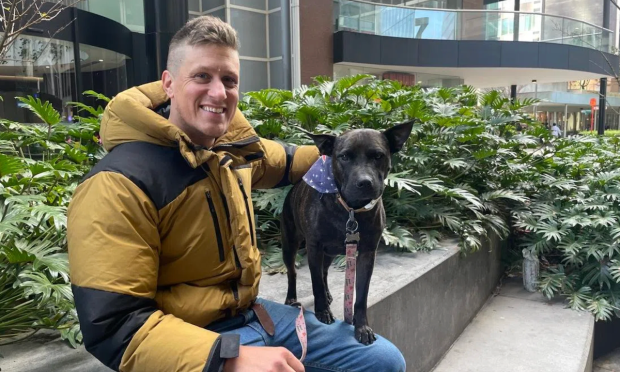
Five months later, that one-off experiment has funding and a business model. Gamgee, founded by Paul Conyngham, was accepted into Y Combinator’s Summer 2026 batch and is now running clinical trials in Australia while accepting cases globally, Conyngham wrote in a Tuesday (Aug. 11) post on X announcing the company’s launch. “My dog Rosie was given months to live. Chemo and immunotherapy failed. I used ChatGPT and computational genomics to design a personalized mRNA cancer vaccine for her tumour. Several of her tumours shrank,” he wrote.
Gamgee sequences a dog’s tumor and healthy DNA side by side, identifies the mutations driving that individual cancer, and designs an mRNA vaccine that teaches the dog’s immune system what to attack, according to the company’s site. The company manages the full chain from vet intake through genomic analysis, manufacturing, treatment and monitoring, according to its Y Combinator profile. Rosie’s vaccine, produced with scientists at UNSW’s RNA Institute, is believed to be the first fully computationally designed mRNA cancer vaccine ever delivered to a dog.
Single Case Does Not Prove the Vaccine Worked
The gap between what happened to Rosie and what Gamgee now aims to accomplish at scale is significant. Rosie’s treatment was a single, uncontrolled case, and mast cell tumors, the type she had, behave unpredictably even without intervention. “We cannot be sure how much of Rosie’s improvement is due to the vaccine, how long it will last, or whether the same approach would help other dogs,” veterinary oncologist Justin Stebbing wrote in The Conversation. One of Rosie’s tumors resisted treatment entirely, prompting a second round of analysis and a follow-up vaccine targeting different mutations, Stebbing noted.
Ashley Kalinauskas, CEO of Torigen, a veterinary cancer immunotherapy company that has treated roughly 2,000 animals, offered a sharper version of the same caution. “It’s super cool, but I think that it’s going to be a challenge to really understand how that could be applied to your everyday dog patient,” Kalinauskas told R&D World. Even a simplified version of what Conyngham did would take months of focused work to replicate, she said. Key details about Rosie’s case, including her tumor’s grade, were never made public, information that matters significantly for interpreting her outcome.
The Real Test for Gamgee Is Reproducibility
Gamgee is not entering an empty field. Personalized mRNA cancer vaccines have been in development for at least a decade in human medicine, with some already in late-stage trials: Moderna and Merck’s mRNA-4157 cut the risk of melanoma recurrence or death by 44% in a randomized trial, Merck said in a 2022 press release.
Veterinary oncology’s current personalized treatments include autologous cancer vaccines, built from a patient’s own tumor tissue, an approach the American Animal Hospital Association’s 2026 oncology guidelines describe as appealing for its individualized nature but still lacking strong peer-reviewed evidence of efficacy. None of those existing approaches sequence a tumor’s genome and design a vaccine around its specific mutations the way Rosie’s did, which is what made her case novel in the first place.
That novelty is also Gamgee’s central business risk. A viral single case is compelling because it is unusual and hard to verify from the outside. A repeatable clinical product has to work the opposite way, producing consistent, measurable outcomes across dogs with different tumor types and disease stages, tested against a control rather than against the emotional weight of one dog’s story.
Conyngham has said Gamgee is actively recruiting veterinary oncologists and trial partners and is seeking funding for a more rigorous study, according to his own X post, an acknowledgment that the evidence supporting the company’s core claim does not yet exist in the form regulators, veterinarians or skeptical pet owners will eventually require.
For all PYMNTS AI and digital transformation coverage, subscribe to the daily AI and Digital Transformation Newsletters.