Companies have upgraded their treasury systems while the payment networks, banks and data they rely on remain fragmented.
The sheer number of ways to move money has increased. Wires and domestic clearing systems remain. Real-time networks have joined them, along with pay-to-card services and other methods. Each payment choice presents a different combination of speed, cost, availability, currency exposure and certainty.
Corporate treasurers have more choices, without having a simple way to choose.
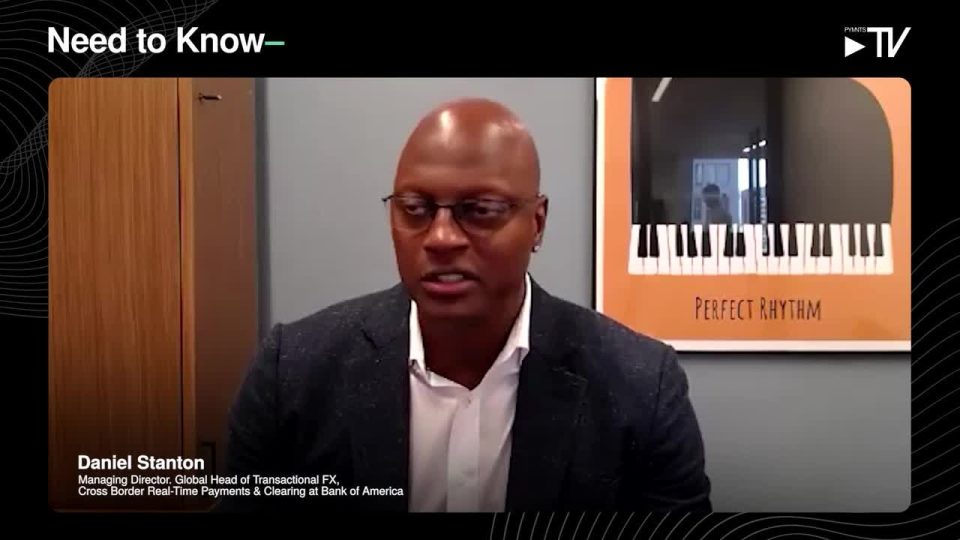
Daniel Stanton, managing director and global head of Transactional FX, Cross Border Real-Time Payments & Clearing at Bank of America, told PYMNTS that companies need to begin with the transaction rather than the rail.
“Treasurers now have to manage across a maze of rails,” Stanton told PYMNTS. Companies, he said, need to identify what use cases they’re solving for and what business outcomes they expect.
A company sending an urgent payment to a supplier may favor speed and availability. Another transaction may put greater weight on cost or foreign-exchange risk. The treasury team is able to apply those priorities only when it is connected to the banking and payment services needed to execute the decision.
Stanton expects systems to become better at choosing among those options based on a company’s requirements. He described an intelligent payment layer capable of selecting a rail based on factors including speed, accessibility and certainty.
Risk has to move just as quickly.
Real-time payments reduce the usefulness of controls that identify a problem after funds have moved. Stanton pointed to beneficiary validation, anomaly detection and risk-based controls as tools that can operate before execution. Corporate systems can also use application programming interfaces (APIs), multifactor authentication and transaction approval requirements before an instruction reaches a bank.
“The best fraud prevention happens before the payment moves and not after,” Stanton added.
Treasury Has Plenty of Data. Connecting It Is Harder
Large companies don’t generally suffer from a shortage of financial information. The trouble is that the information may reside in different places.
We’d love to be your preferred source for news.
Please add us to your preferred sources list so our news, data and interviews show up in your feed. Thanks!
“Many companies have access to significant payment, liquidity, FX and working capital data, but the challenge is connecting that data throughout their ecosystem,” Stanton said.
An enterprise resource planning (ERP) or treasury management system may hold one part of the picture. Banks and payment providers hold others. Without connections among them, a company can own sophisticated treasury technology while employees still reconcile information, intervene in transactions or make decisions using incomplete views of cash.
APIs and standardized payment formats can close some of those gaps. Stanton pointed to ISO 20022 and its richer messaging as one source of information that can support payment decisions.
The benefit of connectivity is practical. A treasury system that knows the company’s priorities and can reach its banking services can use rules to determine how a payment should be handled. Information can return through the same connected environment for cash visibility and forecasting. Fewer steps have to depend on employees moving information between systems.
Stanton summarized what companies should be seeking from the technology as “integration, automation, and creating actionable insights to enable faster decisions.”
Bank of America is one of the institutions building the banking connections on the other side of that corporate technology. Stanton’s remit spans transactional FX, cross-border real-time payments and clearing, areas that have to work with corporate treasury systems if payment selection and execution are to become part of the same process.
New forms of bank money may add another option rather than simplify the landscape by replacing what came before.
Stanton said tokenized deposits could be useful for intercompany settlements and sweeps, as well as atomic settlement and continuous liquidity movements. He stopped short of treating them as the answer for every cross-border transaction.
“Is it going to be a one size fit all? I don’t think so,” Stanton said.
For treasury departments, another software purchase won’t necessarily solve operational fragmentation. The return on technology already sitting inside the company depends on how much of the payment operation it can actually reach.
Watch the full interview with Daniel Stanton to learn more about:
- Why correspondent banking remains part of cross-border payments even as real-time networks expand.
- Where companies can place authentication and payment controls before an instruction reaches their bank.
- Which corporate payment and liquidity uses Stanton sees for tokenized deposits.


 Add as Preferred Source