A shopper who hands a purchase to an artificial intelligence (AI) assistant also hands the merchant a new job at checkout: recognizing the customer behind the software.
That’s the third key finding in “Connecting What’s Next: Open Infrastructure for the Future of Commerce,” the August edition of the PYMNTS Intelligence Optimizing Payments Tracker® series. The report examines how merchants can adapt as AI assistants begin placing orders, more customers use digital wallets and marketplaces pay sellers across borders. Merchants that connect their payment providers through a shared system can change how they handle a transaction or add a payment method without rebuilding checkout each time.
- An AI order needs a recognizable buyer. When an assistant initiates a purchase, the merchant needs a reliable way to connect that request to the customer it represents. The report points to identity checks and connections that let the assistant and the merchant’s checkout software exchange information. Merchants already face a version of that challenge. Among companies with more than $1 billion in annual revenue, 22% reported an increase in cases where their systems flagged legitimate customers as suspicious.
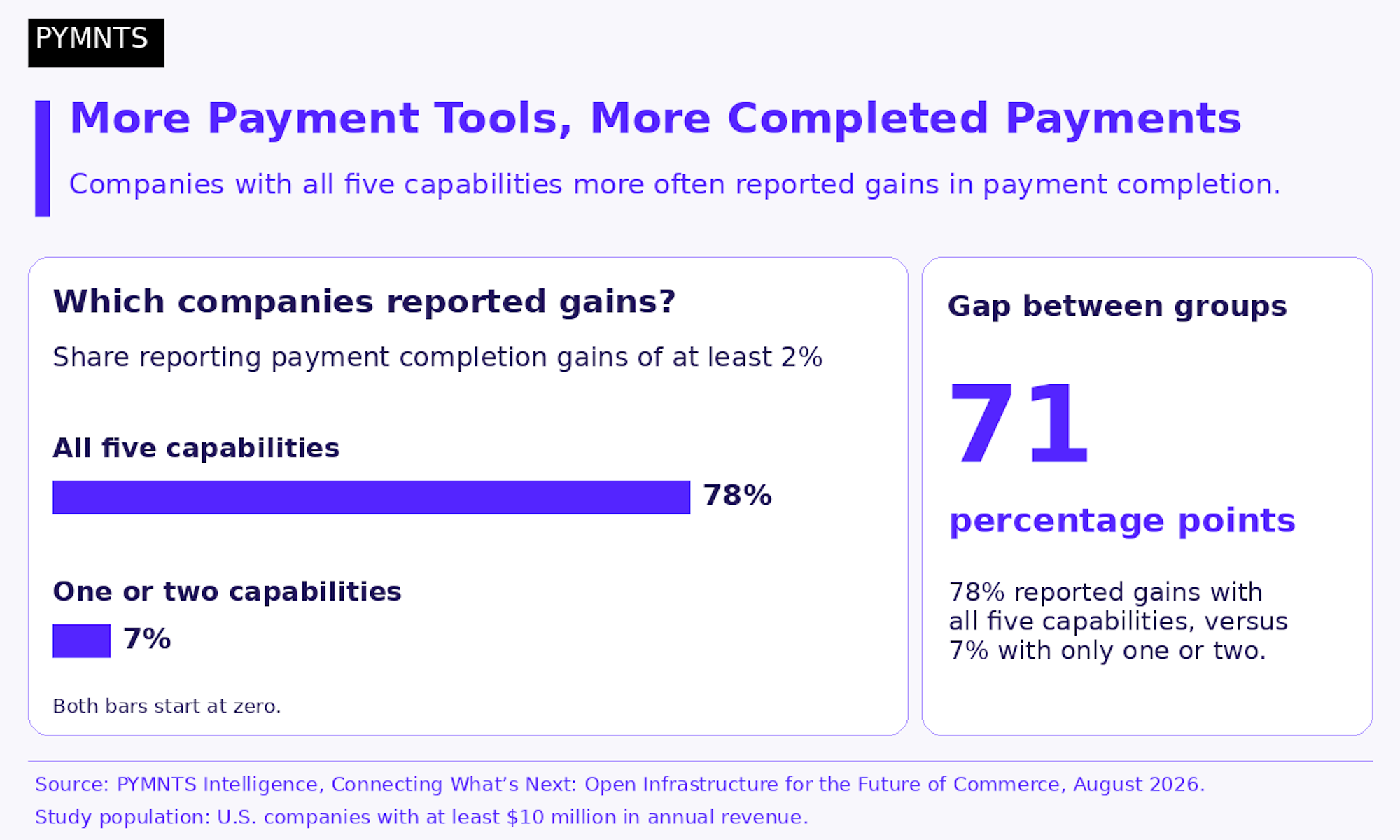
- A second route can keep a payment moving. Think of it as a detour when a familiar road closes. A merchant that uses several processors can send a payment to another one if the first is unavailable. In a U.S. study cited in the report, 78% of companies with all five payment management capabilities reported gains of at least 2% in payment completion. Just 7% of those with one or two capabilities reported comparable gains. That 71-percentage-point difference describes results across payments generally.
- Merchants can add a new way to pay without starting over. One of the five capabilities is the ability to accept another payment method without a major technical overhaul. That gives a merchant room to add a wallet its customers use today and support purchases initiated by an AI assistant as demand develops. PayPal, for example, says its platform can coordinate more than 100 connections to outside payment providers and related services.
For marketplaces, the same approach can help after checkout. A marketplace may collect a buyer’s payment through one system and pay an overseas seller through another, leaving staff to match the records and handle currency conversion. Connecting those steps gives the marketplace a way to follow the money from buyer to seller, whether the customer placed the order personally or sent an assistant to do it.
At PYMNTS Intelligence, we work with businesses to uncover insights that fuel intelligent, data-driven discussions on changing customer expectations, a more connected economy and the strategic shifts necessary to achieve outcomes. With rigorous research methodologies and unwavering commitment to objective quality, we offer trusted data to grow your business. As our partner, you’ll have access to our diverse team of PhDs, researchers, data analysts, number crunchers, subject matter veterans and editorial experts.