The human who approves a merchant account may eventually review fewer files, but the cases left on that person’s desk will demand more judgment.
For Bill Christensen, senior vice president of risk and underwriting at Maverick Payments, the approval most likely to remain with a person concerns a business that falls outside established rules or familiar operating patterns. Automating routine reviews leaves underwriters to determine whether an unusual account can be accepted and under what conditions.
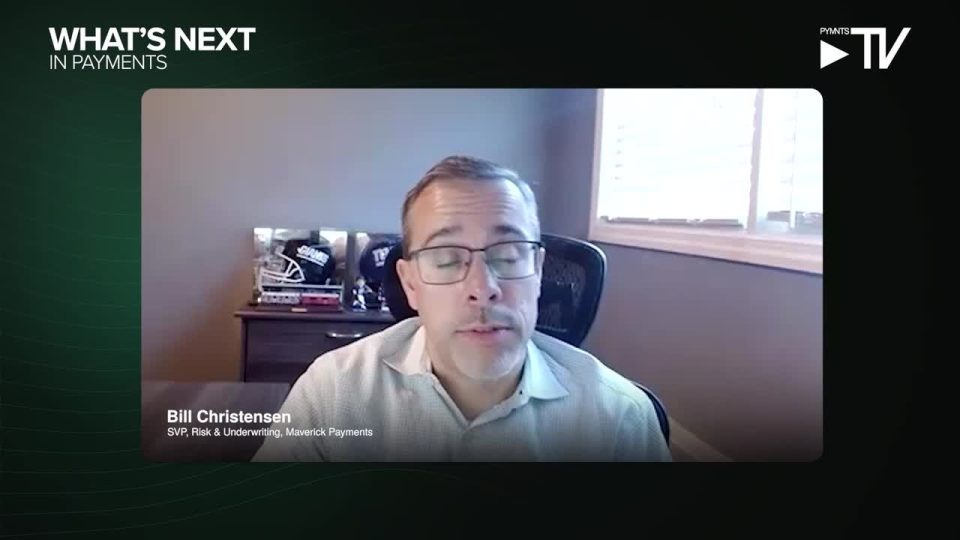
Speaking with PYMNTS for the What’s Next in Payments series, “The Last Thing a Human Will Need to Approve,” Christensen described a future in which people retain authority over exceptions while assuming broader responsibility for the systems handling everyday decisions.
“I don’t think people suddenly disappear from risk decisioning,” he said.
The movement toward automated handling of predictable accounts is expected to continue over the next two or three years. Cases considered borderline today could become routine as information improves, provided models become more reliable and controls mature.
Merchant underwriting illustrates why a final approval can resist automation. Two businesses can look nearly identical in their data yet create different exposures. Christensen cited merchants sharing a merchant category code, despite differences in how they deliver services and operate.
An underwriter needs to understand how each business operates, how it accepts payments and where a loss could arise. Conflicting signals can require further examination before anyone can decide whether the account belongs within acceptable limits.
“That approval is still human because risk is not always binary,” Christensen said. “It’s not just ones and zeros.”
An acceptable account may still require conditions around its approval. Human reviewers must assess whether the proposed controls address the exposure, rather than treat the decision as an unconditional yes or no.
Removing that reviewer would require technology capable of more than matching an application against predefined criteria. A system would need to interpret risk in context, explain its conclusion and remain within a clearly assigned scope of authority, Christensen said.
The test is whether the organization understands the decision well enough to support it and trusts the controls governing the outcome, Christensen said.
We’d love to be your preferred source for news.
Please add us to your preferred sources list so our news, data and interviews show up in your feed. Thanks!
Underwriters Take Responsibility for the Exceptions
Maverick already uses artificial intelligence to auto-board low-risk accounts with predictable profiles, Christensen said. Its automated processes review applications, check compliance signals, assess fraud indicators and identify areas needing attention. Maverick’s underwriters focus on higher-risk cases and true exceptions.
Christensen’s description places limits around the technology’s present role. When information conflicts or a business doesn’t fit a familiar pattern, the case goes to risk professionals for review. Broader automation would require better data, stronger models, transparent decisions and governance over the authority delegated to software.
Christensen illustrated that the potential replacement for an individual approval is a framework combining rules, data, automated analysis and continuous monitoring. Repeatable work could proceed within established limits, with cases outside those limits escalated for review.
People would oversee the framework, monitor results and examine cases requiring their expertise. Their responsibilities would extend beyond approving individual merchants to evaluating how the automated process performs.
“You can automate a decision, but you can’t automate away accountability,” Christensen said.
The organization deploying and relying on a system ultimately owns its outcomes, Christensen said. Vendors, model builders and the people setting rules also have responsibilities, but the operating company must understand the system’s parameters and stand behind its decisions, including mistakes.
Documented escalation procedures, explicit authority limits and ongoing reviews would support that responsibility. Removing a person from each routine approval would still leave people responsible for deciding when software can act and when it must refer a case.
Christensen left open the possibility that the final human approval could disappear if automation eventually supplies sufficient context, explainability and accountability. Until an organization can accept responsibility for decisions outside familiar rules and historical patterns, he said he expects exception approval to remain with a person.
Watch the full interview with Bill Christensen to learn more about:
- How underwriters evaluate merchants with similar profiles but different exposures.
- What automated systems must demonstrate before receiving greater approval authority.
- How human responsibilities could shift toward oversight and exception review.
For all PYMNTS AI coverage, subscribe to the daily AI newsletter.

 Add as Preferred Source