Business payments have been traditionally defined by what they’re not. They’re not simple, they’re not easy, and they’re certainly not fast.
As a result, and for decades, the business payments industry has measured its progress in increments of the inverse those defining qualities. Faster invoice processing would lead to faster approvals and faster settlement, ultimately closing the loop with faster reconciliation. This would make everything simple and easy.
But faster payments are here, and business payments still aren’t simple and easy. That tension was at the center of a recent discussion with John Moodie, vice president of payments at Tungsten Automation, for the November edition of the “What’s Next in Payments” series, “From Good to Great in 2027.”
“Good companies will obviously look to automate more tasks, but great companies will connect those tasks so the business is able to make better financial decisions,” Moodie said, noting that the next breakthrough in financial operations has less to do with how quickly money moves than with how much work remains after it arrives.
After all, improving individual workflows doesn’t necessarily improve the business.
“If payment executions looks fast, but there’s a huge reconciliation work, manual work that happens after that, then you shouldn’t be able to declare victory,” Moodie said.
For CFOs, that distinction could change how automation investments are evaluated, how payment performance is measured and who becomes accountable when supposedly successful transactions create problems elsewhere.
Finance Teams Can Be Overwhelmed by Successful Payments
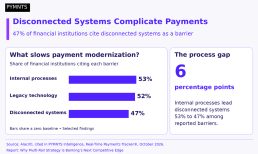
Processing speed and automation rates are relatively straightforward to quantify. The downstream labor, exceptions and supplier friction created by disconnected systems are harder to capture in a single dashboard.
“We need to be careful about what we call transformation,” Moodie said. “We may have just digitalized the process without connecting it together.”
Consider a supplier invoice that moves through an automated approval system, triggers an electronic payment and settles successfully. By conventional operational metrics, the process worked. But the supplier may still lack visibility into payment status. Treasury may have missed an opportunity to optimize working capital. And accounts payable may still need to manually reconcile the transaction against the original obligation.
Moodie argued that payment performance should ultimately be judged by whether the original financial obligation was fulfilled correctly, the supplier understands the outcome and the company’s books accurately reflect the transaction.
“I would stop approving technology investments on the strength of, say, a single feature or a single departmental use case,” he said.
Finance teams frequently evaluate automation products against narrowly defined departmental objectives: reducing invoice handling time, lowering transaction costs or accelerating payment execution. Those improvements can be meaningful. But a tool delivering savings in one function can inadvertently generate additional work in another.
“What work actually disappears in that full end-to-end? What risks are we reducing? And then what does happen downstream after that tool has taken effect?” Moodie said.
A payment method with attractive transaction economics, for example, may prove poorly suited to a company’s supplier base. The resulting exceptions and manual interventions could erase savings elsewhere.
AI’s Next Challenge Is Authority, Not Autonomy
The same discipline applies to artificial intelligence, instant payments and digital assets.
Moodie sees opportunities for AI to interpret invoices, identify exceptions, recommend payment approaches within established policies and match transactions to underlying obligations.
But those capabilities become more consequential when they support a defined financial objective rather than simply automate another activity.
“The distraction is pursuing autonomy before defining authority,” he said.
That distinction matters as businesses consider giving AI systems greater responsibility for financial decisions. Before allowing technology to act, executives must establish what it can decide, which controls apply, when human intervention is required and how outcomes will be verified.
Instant payments face a similar test. Moving funds immediately can create value when speed serves a business need. It can also undermine working capital objectives if faster execution becomes the default rather than a deliberate choice.
For Moodie, the relevant innovation is not necessarily the fastest payment rail or most autonomous system. It is the ability to connect invoice terms, supplier relationships, liquidity requirements and payment execution into a coherent decision.
As he put it, “Great leadership isn’t having the most visible technology agenda, but it’s about creating an organization that consistently delivers on its financial commitments and KPIs.”
Watch the full interview with Tungsten Automation VP John Moodie to learn why:
- Automation can move costs instead of eliminating them. Faster invoice processing means little if reconciliation, supplier inquiries and exception handling still require manual work. CFOs need to measure the total cost of a completed payment.
- AI’s biggest payments constraint may be decision rights. Autonomous execution creates value only when financial authority, policy controls and human escalation are clearly defined. Faster decisions are not necessarily better decisions.
- The next finance KPI is end-to-end accountability. AP, treasury, procurement and payments can each hit their targets while the business misses its own. Competitive advantage increasingly depends on aligning those functions around working capital and financial outcomes.