For small businesses in the United States, the clearest growth opportunities increasingly sit beyond the storefront.
“Why Main Street’s Digital Survivors Are Pulling Ahead: Four Years of Small Business Data” drew on 23 PYMNTS Intelligence surveys conducted from July 2022 through February 2026. The research covered U.S. businesses with up to $10 million in annual revenue. It found a sector that is growing more confident and more digital.
In February, 51% of small- to medium-sized businesses (SMBs) reported higher revenue than a year earlier, while the share reporting lower revenue fell to 13% in February from 22% in July 2022. Still, the gains were uneven. Businesses with more than $1 million in annual revenue grew 13.7% on average from 2020 levels, compared with 0.6% for those earning $150,000 or less.
Key findings from the report:
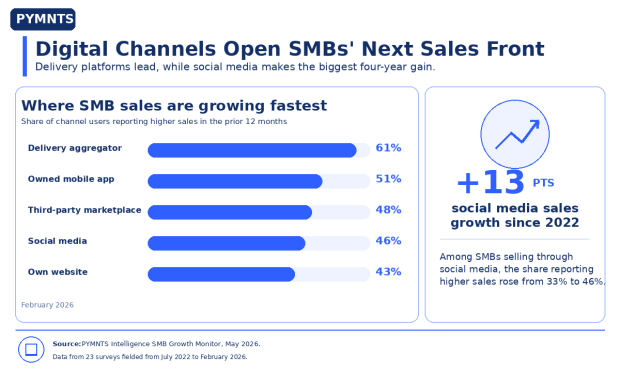
- Digital channels carry the momentum. Among businesses using each channel, 61% of delivery-aggregator users reported higher sales there during the prior 12 months, up from 49% in January 2022. Social media posted the largest gain, rising 13 percentage points to 46%. Owned websites were nearly as common as physical stores, 57% versus 61%. For a smaller company, a digital storefront can serve as a second front door without the expense of opening another location.
- Payment gaps create room to grow. Credit card acceptance stood at 79% both in stores and online, but newer methods were uneven. Apple Pay acceptance reached 32% online and 30% in stores. Venmo stood at 41% online and 36% in stores, while buy now, pay later reached 13% online and 8% in stores. That gives payment providers and merchants an opening to make digital options more consistent across channels as cash acceptance gradually declines.
- Financing can support expansion. Among SMBs seeking outside capital, 37% said they borrowed as a strategy, and another 28% cited both strategy and necessity. Only 13% named an inability to secure financing as a survival risk. The figures suggest providers can compete through useful products, including working capital tools linked to invoices or sales activity and faster decisions.
The report also showed what owners believe is working. The share who cited stronger customer demand as a lift to financial health was 40%, followed by lower operating costs at 32%, more effective marketing at 29%, new products or services at 23% and improved cash flow management at 22%. Risks haven’t disappeared, as 58% cited poor economic conditions and 38% named competition from larger chains. Even so, the data pointed to a practical opportunity.
Small businesses can adopt more of the channel, payment and financing practices already associated with stronger growth among larger SMBs.
At PYMNTS Intelligence, we work with businesses to uncover insights that fuel intelligent, data-driven discussions on changing customer expectations, a more connected economy and the strategic shifts necessary to achieve outcomes. With rigorous research methodologies and unwavering commitment to objective quality, we offer trusted data to grow your business. As our partner, you’ll have access to our diverse team of PhDs, researchers, data analysts, number crunchers, subject matter veterans and editorial experts.