A business owner might put an inventory order on a credit card to prepare for a busy season or because there’s no cash to pay the supplier. The charge looks the same to the lender. The reason behind it says more about how the business is doing.
PYMNTS Intelligence’s “Borrowing Room: How Business Size Shapes Credit Access and Growth” draws on 10,523 responses across 20 survey editions, including a September survey of 509 U.S. businesses. Among September borrowers, 44% said they used credit mainly to manage operations or fund growth, which the report calls strategic borrowing. Another 34% borrowed mainly to cover expenses they couldn’t otherwise meet. Businesses in the first group more often reported rising revenue and expressed greater confidence about staying open.
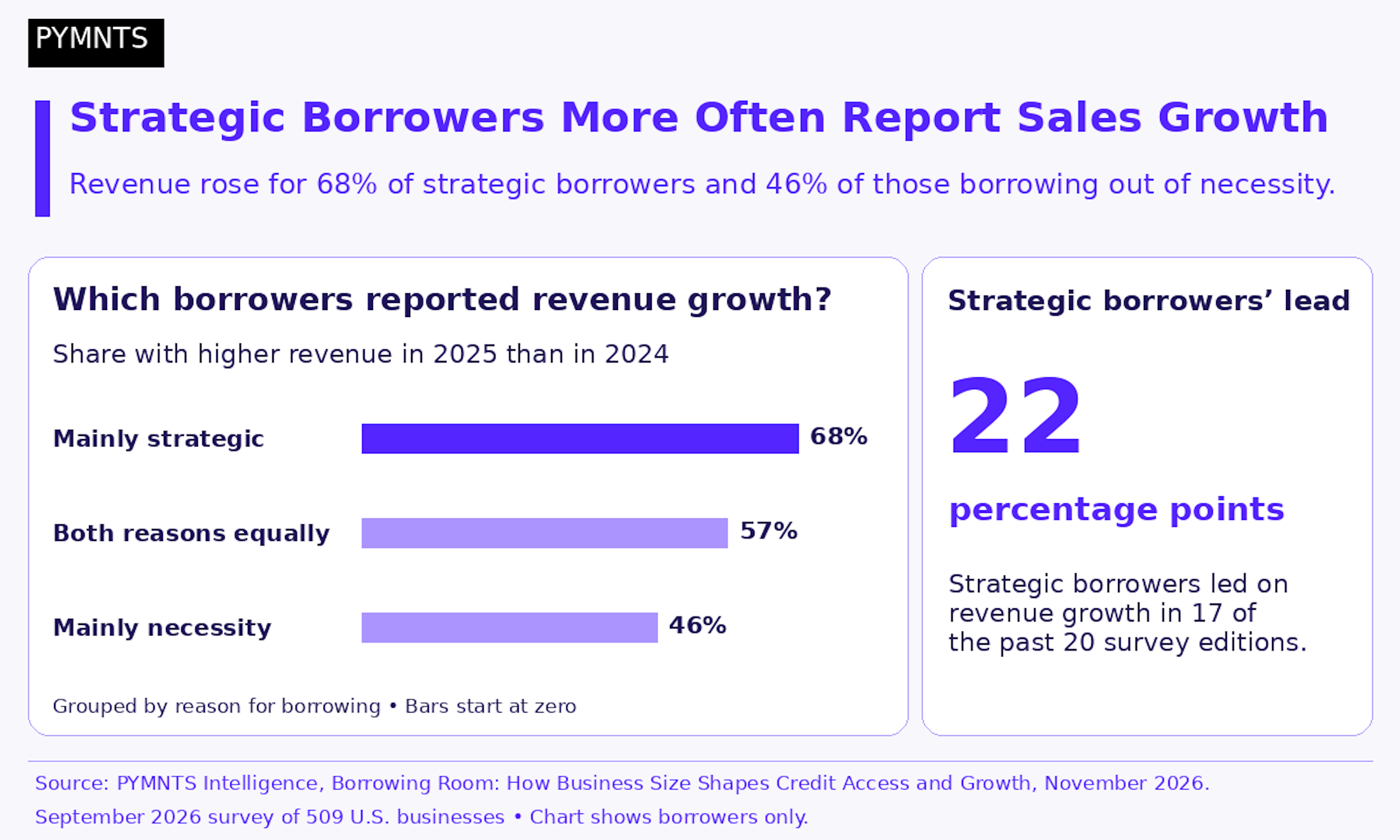
- Revenue growth was more common among strategic borrowers. In September, 68% of businesses that borrowed mainly for strategic purposes said their revenue rose in 2025 compared with 2024. That compares with 57% of borrowers who gave strategy and necessity equal weight and 46% of those who borrowed mainly out of necessity. Strategic borrowers reported growth more often than necessity borrowers in 17 of the 20 survey editions. The survey didn’t establish whether borrowing produced those gains.
- Larger businesses had more room to plan. Among borrowers with $1 million to $10 million in annual revenue, 55% used credit mainly to manage or grow the business. That share fell to 33% among those with revenue of $150,000 or less. For the smallest borrowers, covering bills they otherwise couldn’t pay was the most common reason to use credit. Some 48% cited it, compared with 20% of the largest borrowers.
- Strategic borrowers also felt more confident about staying open. Asked about the next two years, 94% of strategic borrowers said they were very or extremely likely to remain in business. Among those borrowing mainly out of necessity, 82% said the same. Strategic borrowers expressed greater confidence in every one of the 20 survey editions.
Sometimes the value of credit lies in having it available. Among businesses that could borrow and chose not to, 89% felt very or extremely likely to stay open for the next two years. For those owners, an unused line of credit can serve as a spare tire. For lenders, understanding when an owner expects to draw on that line can help distinguish a planned purchase from a bill that’s already due.
At PYMNTS Intelligence, we work with businesses to uncover insights that fuel intelligent, data-driven discussions on changing customer expectations, a more connected economy and the strategic shifts necessary to achieve outcomes. With rigorous research methodologies and unwavering commitment to objective quality, we offer trusted data to grow your business. As our partner, you’ll have access to our diverse team of PhDs, researchers, data analysts, number crunchers, subject matter veterans and editorial experts.