Real-time payment usage varies drastically among firms of different sizes, according to “Accelerating the Time to Realized Revenue,” a PYMNTS and Mastercard collaboration based on a survey of 400 corporate executives.
Get the report: Accelerating the Time to Realized Revenue
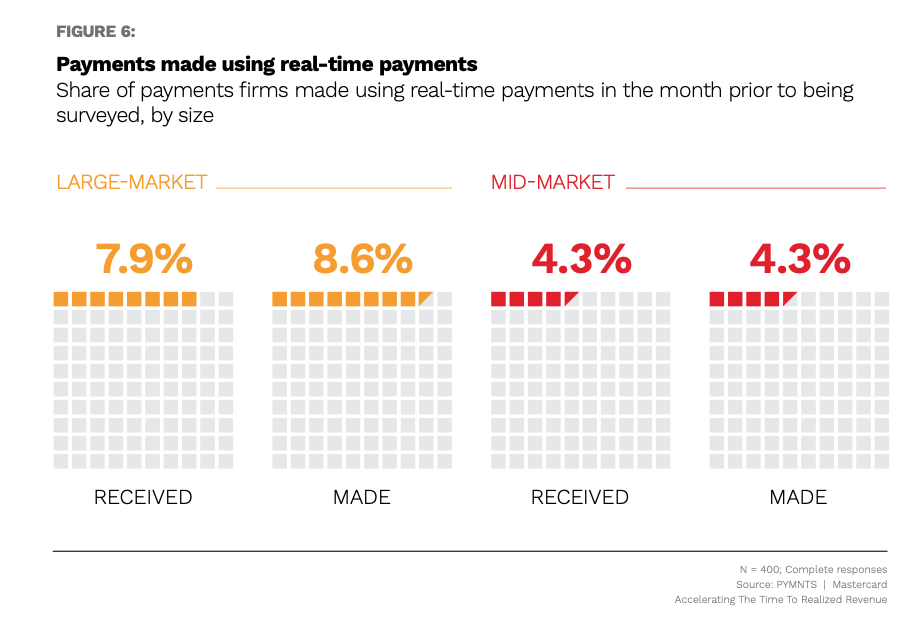
Large-market U.S. firms (those that generate more than $1 billion in annual revenue) use real-time payments to make and receive twice as many business-to-business (B2B) payments as mid-market U.S. firms (which generate between $20 million and $1 billion).
On average, large-market businesses use real-time payments in about 8% of the payments received and 9% of the payments made.
By contrast, the average mid-market firm receives 4% and makes 4% of its payments via real-time payment rails.
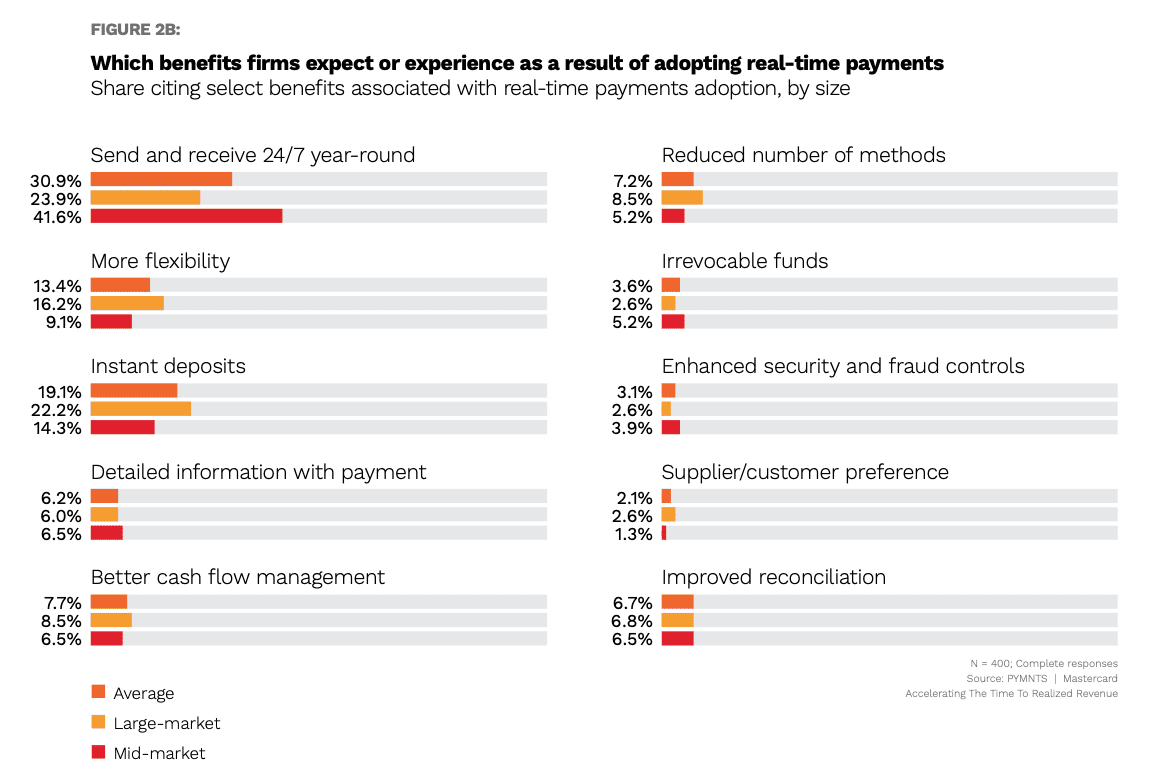
Firms of different sizes get the same benefits from using real-time payments, though the percentages of the firms citing those benefits vary.
We’d love to be your preferred source for news.
Please add us to your preferred sources list so our news, data and interviews show up in your feed. Thanks!
Advertisement: Scroll to Continue
Both say the ability to send and receive 24/7 year-round is the top benefit they expect or experience as a result of adopting real-time payments, with 24% of large-market U.S. firms and 42% of mid-market U.S. firms saying so.
The second most cited benefit is instant deposits, which is named by 22% of large-market firms and 14% of mid-market firms.
The third-ranked benefit among companies of both sizes is more flexibility, with 16% of large-market firms and 9% of mid-market firms saying that’s a benefit of adopting real-time payments.
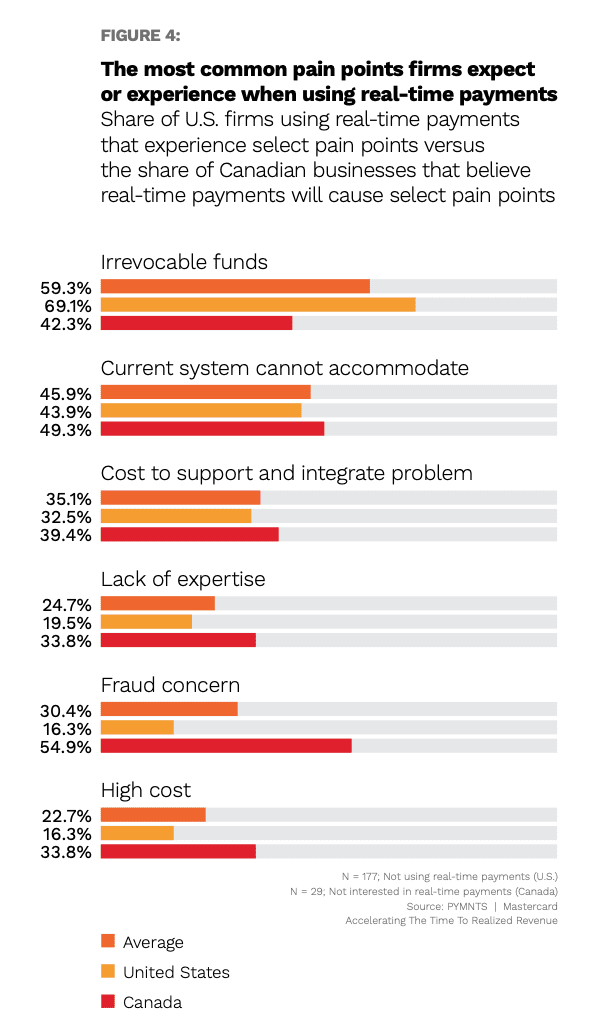
On average, the most common pain points firms expect or experience when using real-time payments are irrevocable funds, current system cannot accommodate and the cost to support or integrate is a problem. These were cited by 59%, 46% and 35%, respectively, of the firms that were surveyed.
With large-market firms making and receiving nearly twice as many real-time payments as mid-market firms, they may benefit from the advantages of real-time payments to a much larger degree than smaller firms. This could put mid-market firms at a competitive disadvantage.


 Add as Preferred Source